United States
 United Kingdom
 Canada
 Australia
 United Arab Emirates
 Saudi Arabia
 Denmark
 France
 Germany
 Indonesia
 Ireland
 Morocco
 Netherlands
 New Zealand
 Norway
 Singapore
 South Africa
 Sweden
 Turkey
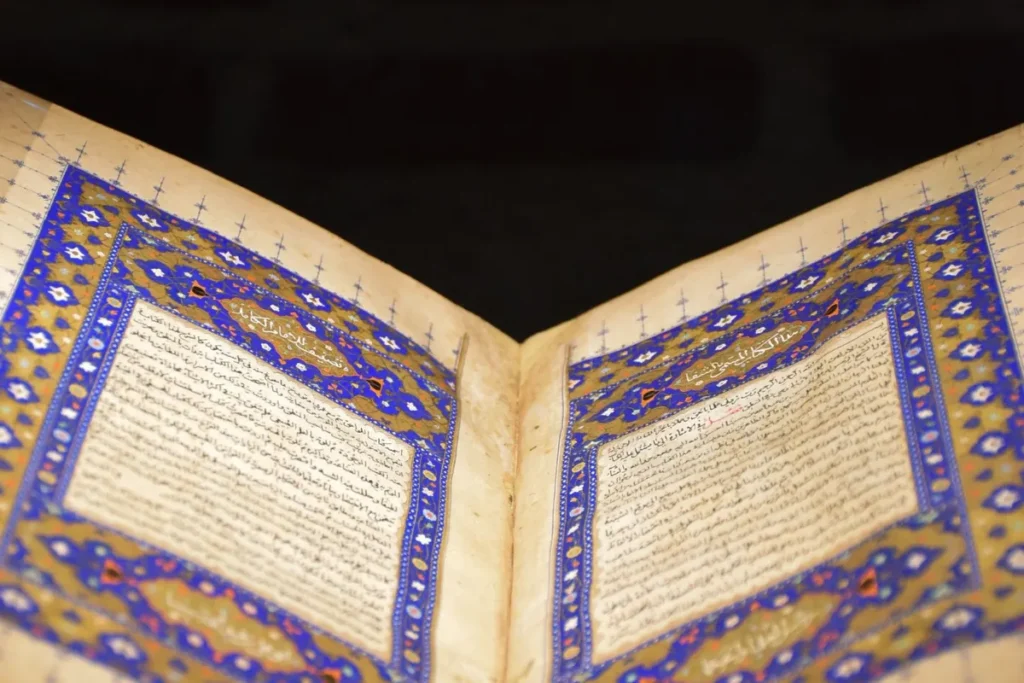
Bismillah means “In the name of Allah.” It is the short form of the phrase Bismillah ir-Rahman ir-Rahim, “In the name of Allah, the Most Gracious, the Most Merciful”, which opens every chapter of the Quran except one. Muslims say “Bismillah” before eating, drinking, reciting the Quran and starting everyday tasks, as a way of beginning with Allah’s name and seeking His blessing. This guide explains the Bismillah meaning word by word, where it appears in the Quran, when to say it according to the Sunnah, and how to pronounce it correctly.
Bismillah in Arabic
The full phrase, as it appears at the start of Surah Al-Fatiha, is:
Arabic text: Quran 1:1, from Quran.com.
Transliteration: Bismillahir-Rahmanir-Rahim
Meaning: In the name of Allah, the Most Gracious, the Most Merciful.
Bismillah meaning, word by word
| Arabic | Transliteration | Meaning |
|---|---|---|
| بِ | bi | in, with |
| اسْمِ | ism | the name (of) |
| اللَّهِ | Allah | Allah, the proper name of God |
| الرَّحْمَٰنِ | ar-Rahman | the Most Gracious, whose mercy is vast and covers all creation |
| الرَّحِيمِ | ar-Rahim | the Most Merciful, who shows constant, specific mercy |
Notice that the letter alif in ism is not written in the Bismillah. It is dropped because the phrase is used so often, which is why it is spelled بِسْمِ rather than بِاسْمِ.
What is the difference between ar-Rahman and ar-Rahim?
Both names come from the same root, ra-ha-meem, meaning mercy. Scholars have explained the difference in a few ways. A common explanation is that ar-Rahman describes mercy that is vast and reaches all of creation in this world, while ar-Rahim describes mercy that is continuous and is shown especially to the believers, including in the Hereafter. Others say ar-Rahman describes Allah’s essential attribute and ar-Rahim describes that mercy in action. Both explanations agree that the Bismillah begins every task by remembering Allah’s mercy.
If you would like to learn more words this way, see our guide to learning the Quran word by word.
Teaching your children to read Arabic and the Quran? Our one-to-one lessons start from the first letters and build up to reading phrases like the Bismillah correctly. Book a free trial class.
Where Bismillah appears in the Quran
- At the start of 113 surahs. Every surah begins with the Bismillah except Surah At-Tawbah (chapter 9).
- Inside Surah An-Naml. The Bismillah appears within verse 30 of Surah An-Naml (27:30), at the start of the letter Prophet Sulayman (Solomon) sent to the Queen of Sheba. You can read it on Quran.com.
- 114 times in total. Because of the extra occurrence in An-Naml, the Bismillah appears 114 times, the same as the number of surahs.
Is the Bismillah a verse of Surah Al-Fatiha?
This is a well-known difference of opinion among scholars. In the Shafi’i school, the Bismillah is counted as the first verse of Al-Fatiha, and the common Hafs numbering of the Mushaf also counts it as verse 1. In the Hanafi school it is a separate verse of the Quran placed at the start of surahs to divide them, rather than part of Al-Fatiha itself, while the Maliki view is that it is not counted as a verse at the start of surahs. All agree that it is part of the Quran within Surah An-Naml and that it is written at the start of surahs in the Mushaf.
Why does Surah At-Tawbah not start with Bismillah?
Scholars have given several explanations. One is that the Bismillah is a message of mercy and safety, while Surah At-Tawbah opens with a declaration of disassociation addressed to those who had broken their treaties. Another explanation, reported from the companions, is that At-Tawbah was treated as closely connected to the surah before it, Al-Anfal. Either way, the Bismillah is not recited at its start when reading in sequence.
When to say Bismillah: the Sunnah practice
| Situation | What to say | Source |
|---|---|---|
| Before eating | Bismillah | The Prophet ﷺ told a young boy, “Mention the name of Allah, eat with your right hand and eat from what is in front of you.” (Sahih al-Bukhari 5376) |
| If you forget at the start of a meal | Bismillahi awwalahu wa akhirahu (“In the name of Allah at its beginning and its end”) | Sunan Abi Dawud 3767 |
| Entering the home | Mention Allah’s name when entering and when eating | Sahih Muslim 2018 |
| Starting a surah of the Quran | Bismillah ir-Rahman ir-Rahim | Recited at the start of each surah except At-Tawbah |
| Before wudu | Bismillah | Recommended by most scholars; some consider it obligatory |
In everyday life, many Muslims also say “Bismillah” before getting into a car, starting work, taking an exam or beginning any worthwhile task. Saying it reminds you to begin with the right intention and to rely on Allah.
Bismillah or the full Bismillah ir-Rahman ir-Rahim?
For daily actions such as eating, the short “Bismillah” is enough. The full phrase is used when beginning a surah of the Quran and is also commonly written at the start of letters and documents, following the example of the letters the Prophet ﷺ sent.
How to pronounce Bismillah correctly
- The S is light: say bis with a light س, not a heavy ص.
- The lam in “Allah” is light here: because it comes after a kasra (the “i” of bismi), the lam is pronounced thin, not heavy. Compare it with “Allahu Akbar”, where it is heavy.
- The ra in “ar-Rahman” is heavy: it carries a fatha, so it is pronounced full.
- The ha is from the throat: the ح in Rahman and Rahim is a breathy sound from the middle of the throat, not an English “h”.
- Stopping on “ar-Rahim”: when you stop, the final meem takes a sukoon and the long “ee” sound can be stretched slightly.
These points are part of Tajweed. Our Tajweed rules for beginners guide explains them in more detail, and our guide to the Arabic alphabet covers the letters.
Teaching Bismillah to children
- Start with the habit. Say “Bismillah” out loud before every meal so children copy it naturally.
- Explain it simply. “We start with Allah’s name because everything good comes from Him.”
- Teach the full phrase next. Once children say “Bismillah” easily, teach the full Bismillah ir-Rahman ir-Rahim as their first line of the Quran.
- Practice the sounds. Young learners often struggle with ح. Make a game of the “warm breath” sound.
For children who are starting to read Arabic, the Noorani Qaida course is the usual first step, followed by Quran classes for kids. You may also enjoy our guide to common Arabic phrases Muslims use every day.
Frequently asked questions
What does Bismillah mean?
Bismillah means “In the name of Allah.” The full phrase, Bismillah ir-Rahman ir-Rahim, means “In the name of Allah, the Most Gracious, the Most Merciful.”
When should a Muslim say Bismillah?
Before eating and drinking, when entering the home, before wudu, when starting to recite a surah of the Quran, and before beginning any worthwhile task.
How many times is Bismillah mentioned in the Quran?
114 times: at the start of 113 surahs, and once inside verse 30 of Surah An-Naml. Surah At-Tawbah is the only surah that does not begin with it.
Can non-Muslims say Bismillah?
Yes. It is a phrase of the Arabic language meaning “in the name of God”, and anyone can say it. Many Arabic-speaking Christians also use it.
Is it Bismillah or Bismallah?
The correct pronunciation is “Bismillah”, with an “i” sound after the M. “Bismallah” is a common misspelling.
Begin with Bismillah
The Bismillah is often the first phrase a Muslim child learns and the first words of the Quran. Saying it with understanding and correct pronunciation turns a small habit into a daily reminder of Allah’s mercy. If you would like to learn to read the Quran from the beginning, find the right Quran learning program or contact Home Quran Tutors.
Start your Quran journey with a teacher. One-to-one online lessons for children and adults, from the first letters to fluent recitation.
Written by the Home Quran Tutors team. This article is general guidance for learners and parents; for religious rulings, please ask your teacher or a qualified scholar you trust.