United States
 United Kingdom
 Canada
 Australia
 United Arab Emirates
 Saudi Arabia
 Denmark
 France
 Germany
 Indonesia
 Ireland
 Morocco
 Netherlands
 New Zealand
 Norway
 Singapore
 South Africa
 Sweden
 Turkey
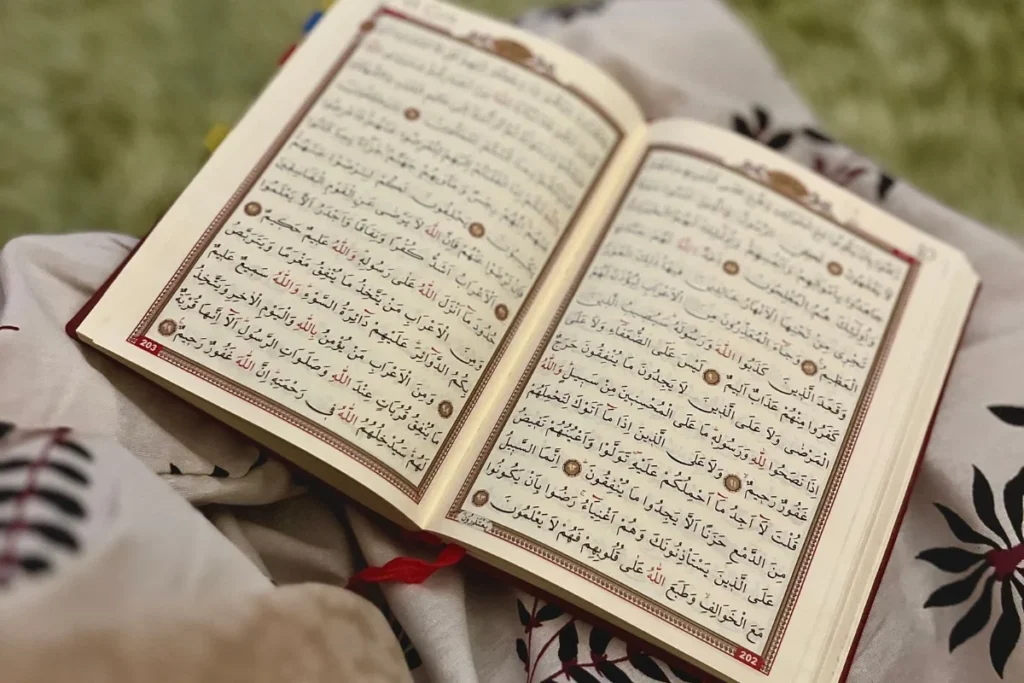
Quran stop signs (called rumuz al-awqaf, the symbols of stopping) are small marks printed above the lines of the Mushaf that tell you where you must stop, where you may stop, and where you should keep reading. The most common ones are مـ (you must stop), لا (do not stop), ج (stopping is allowed), صلى (better to continue), قلى (better to stop) and ∴ ∴ (stop at one of the two places, not both). Following them keeps the meaning of each verse intact. This guide explains each sign, the extra symbols in South Asian Mushafs, and how to stop correctly.
Different printings of the Quran use slightly different symbols. Check the key at the back of your own Mushaf, and ask a teacher if a sign is unclear.
Why stopping in the right place matters
Arabic sentences in the Quran can carry very different meanings depending on where you pause. Stopping in the middle of a phrase can separate a word from what it describes, or join two ideas that should be kept apart. The stop signs were added by scholars to protect the meaning and to help readers breathe at sensible places. They are a guide to good recitation; the end-of-verse circle, by contrast, simply marks where one verse finishes.
Stopping well is part of Tajweed, alongside correct pronunciation. If you are new to the rules, our Tajweed rules for beginners guide is a good companion to this one.
Stop signs in the Madinah Mushaf
Many Muslims in the US and UK read from a Madinah-style Mushaf (the Uthmani script printed in Saudi Arabia and widely used in mosques). It uses six main signs:
| Sign | Name | What it means |
|---|---|---|
| مـ | Waqf lazim | You must stop. Continuing could give a wrong meaning. |
| لا | Do not stop | Keep reading. If you stop here by necessity, go back and start from an earlier word. |
| ج | Waqf ja’iz | Stopping and continuing are equally fine. |
| صلى | Al-wasl awla | You may stop, but continuing is better. |
| قلى | Al-waqf awla | You may continue, but stopping is better. |
| ∴ ∴ | Mu’anaqah (embracing stop) | Two sets of three dots close together. Stop at one of them, not at both. |
A small س marks a saktah: a very short pause without taking a breath. In the common Hafs recitation there are four well-known places for it, including after عِوَجًا in the first verse of Surah Al-Kahf and after مَرْقَدِنَا in Surah Ya-Sin, verse 52.
Not sure where to breathe when you read? A teacher can read a page with you and show you, line by line, where to pause and where to keep going. Book a free evaluation lesson and get started.
Extra signs in South Asian (IndoPak) Mushafs
Many families of Pakistani, Indian and Bangladeshi heritage, in both Britain and America, read from 13-line or 15-line IndoPak Mushafs. These use a wider set of symbols. The meanings below are the ones commonly given in the key of these printings:
| Sign | Common meaning |
|---|---|
| ط | Waqf mutlaq: stop here. |
| م | Waqf lazim: you must stop. |
| ج | Stopping is allowed (and often preferred). |
| ز | Stopping is allowed, but it is better to continue. |
| ص | Better to continue; you may stop if you are out of breath. |
| صلے | Continuing is better. |
| ق | Some scholars said to stop here; continuing is better. |
| قف | Stop. |
| لا | Do not stop. |
| ك | Same as the previous sign. |
| س or سکتہ | Saktah: a brief pause without breathing. |
| وقفہ | A slightly longer pause, still without breathing. |
| ∴ ∴ | Stop at one of the two places, not both. |
You will also see the letter ع in the margin. This marks the end of a ruku’, a section of reading, rather than a stop sign.
How to stop on a word correctly
When you stop, the last letter of the word is usually read with a sukoon. A few simple rules cover most cases:
- Final vowel: drop it. الرَّحِيمِ becomes ar-raheem when you stop.
- Tanween with fatha (ـً): change it to a long “aa”. عَلِيمًا is read ‘aleemaa.
- Tanween with kasra or damma: drop it. عَلِيمٌ is read ‘aleem.
- Ta marbutah (ة): change it to a soft “h”. رَحْمَةٌ is read rahmah.
- Qalqalah letters: if the last letter is ق ط ب ج د, give it a clear bounce. Our guide to qalqalah letters explains how.
Starting again after a stop
Where you start again matters as much as where you stop. If you had to stop at a place marked لا, or in the middle of a phrase because you ran out of breath, go back a word or two and begin from a point that makes sense. Starting from a word that changes the meaning, or that begins halfway through an idea, should be avoided.
Practical tips for beginners
- Read short sections. At first, stop only at the end of verses and at مـ. Add the other signs as you grow more confident.
- Look one or two words ahead. This helps you see a stop sign coming and plan your breath.
- Listen to a slow reciter. Notice where they pause in a passage you know, and copy the pattern.
- Do not stop on a word just because the line ends. In many Mushafs the line ends in the middle of a sentence.
- Ask about your own Mushaf. If your family uses an IndoPak print and your child’s teacher uses a Madinah one, a good teacher will explain both.
If you are still building basic reading, the Quran for beginners and reverts course covers reading fluency before moving on to stopping and starting. For a step-by-step plan, see how to learn Quran online as a beginner.
Lessons that fit US and UK schedules
Lessons are live and one-to-one, so a teacher can follow your Mushaf, whichever print it is. US families usually choose times in their own time zone, often after school or after work. UK families often prefer after-school or weekend slots, adjusted when the clocks change between GMT and BST. You can find more on our online Quran classes in the UK and online Quran classes in the USA pages.
Frequently asked questions
What does the م sign mean in the Quran?
The م (meem) sign marks a compulsory stop (waqf lazim). Continuing past it could join two phrases in a way that changes the meaning, so you should stop there.
What does لا mean in the Quran?
لا means do not stop. If you have to stop there, for example to take a breath, go back and start again from a suitable earlier word.
What do the three dots mean in the Quran?
Two sets of three dots (∴ ∴) mark a mu’anaqah stop. You may stop at either set, but not at both.
Is it a sin to ignore the stop signs?
The signs are guidance from scholars to protect the meaning. They are not verses of the Quran. Readers are encouraged to follow them, and to take particular care with the compulsory stop and the do-not-stop sign. For a ruling on your own situation, ask a scholar you trust.
What is a saktah?
A saktah is a very short pause without taking a breath, marked with a small س. In the Hafs recitation it appears in a few specific places.
Read with a teacher
Stopping and starting well comes from reading aloud with someone who knows where to pause. Book a free evaluation lesson to have your reading checked, or message us on WhatsApp. If you already know which course you want, you can also enrol directly.
Build smooth, confident recitation. One-to-one online Quran lessons for children and adults, with Madinah or IndoPak Mushafs.
Written by the Home Quran Tutors team. This article is general guidance for learners and parents; for religious rulings, please ask your teacher or a qualified scholar you trust.