United States
 United Kingdom
 Canada
 Australia
 United Arab Emirates
 Saudi Arabia
 Denmark
 France
 Germany
 Indonesia
 Ireland
 Morocco
 Netherlands
 New Zealand
 Norway
 Singapore
 South Africa
 Sweden
 Turkey

Qalqalah is the slight echo or bounce you hear when one of five Arabic letters is pronounced with a sukoon (no vowel). The five qalqalah letters are ق ط ب ج د (qaf, ta, ba, jeem and dal), which teachers group into the easy phrase قُطْبُ جَدٍّ (qutbu jad). Without that small bounce, these letters would sound swallowed or cut off. This guide explains which letters have qalqalah, when the rule applies, the different levels, and how to practise it so it sounds natural.
Qalqalah is learned by ear. Read this guide to understand the rule, then listen to a clear reciter and ask a teacher to check your recitation.
What does qalqalah mean?
The Arabic word qalqalah means to shake or disturb. In Tajweed it describes a short vibration that comes out of the letter’s articulation point when the letter carries a sukoon. The letters ق ط ب ج د are “strong” letters: the air is fully blocked when you say them (a quality called shiddah) and the voice does not flow with them (jahr). When one of them has no vowel, the sound would disappear unless the tongue or lips release it with a small bounce. Qalqalah is that release.
It is one of the qualities of letters (sifaat) that you meet early when learning Tajweed. If you want to see how it fits with the other rules, our overview of Tajweed rules for beginners puts it in context.
The five qalqalah letters
| Letter | Name | Example with sukoon | Where it is from |
|---|---|---|---|
| ق | Qaf | يَقْطَعُونَ (yaq-ta’oon) | Back of the tongue against the soft palate |
| ط | Ta (heavy) | يَطْمَعُ (yat-ma’u) | Tip of the tongue against the upper gum, with a full, heavy mouth |
| ب | Ba | يَبْخَلُ (yab-khalu) | Both lips pressed together |
| ج | Jeem | يَجْعَلُونَ (yaj-‘aloon) | Middle of the tongue against the roof of the mouth |
| د | Dal | قَدْ أَفْلَحَ (qad aflaha) | Tip of the tongue against the upper gum |
Notice that the light ت (ta) and the ك (kaf) are not qalqalah letters, even though they also sound “strong” to English speakers. Bouncing them is one of the most common beginner mistakes.
When does qalqalah apply?
Qalqalah applies only when a qalqalah letter has a sukoon. That happens in two situations:
- The sukoon is written in the word. For example, the dal in قَدْ or the jeem in يَجْعَلُونَ. You make the bounce whether you are stopping or reading on.
- The sukoon comes from stopping. When you stop at the end of a word, its last vowel is dropped. If that last letter is a qalqalah letter, it now has a sukoon, so it gets qalqalah. For example, when you stop on الْفَلَقِ at the end of the first verse of Surah Al-Falaq, it is read al-falaq with a clear bounce on the qaf.
If the letter has a fatha, kasra or damma (for example بَ, بِ or بُ), there is no qalqalah, because the vowel already carries the sound out.
Learning to read the Quran with Tajweed? A teacher can hear the difference between a clean qalqalah and an added vowel much faster than you can on your own. Try a free one-to-one evaluation lesson and get feedback on your recitation.
The levels of qalqalah
Teachers describe qalqalah in levels, from lightest to strongest. Many teach two levels; some add a third for a letter with shaddah at a stop.
Qalqalah sughra (minor)
This is the lightest bounce. It happens when the sukoon is in the middle of a word, or at the end of a word that you are joining to the next one. Examples: يَقْطَعُونَ, يَبْتَغُونَ, and لَمْ يَلِدْ وَلَمْ يُولَدْ when you read straight through Surah Al-Ikhlas without stopping after يَلِدْ.
Qalqalah kubra (major)
This is a stronger, clearer bounce. It happens when you stop on a qalqalah letter at the end of a word, usually at the end of a verse. Examples: أَحَدْ at the end of the first verse of Surah Al-Ikhlas, and الْفَلَقْ in Surah Al-Falaq. Because you are stopping, the sound needs to be released clearly so the last letter is heard.
The strongest level (with shaddah)
Some teachers name a further level, sometimes called qalqalah akbar, for stopping on a qalqalah letter that has a shaddah. For example, stopping on وَتَبّْ at the end of the first verse of Surah Al-Masad, or on الْحَقّْ. The letter is held for a moment because of the shaddah and then released with the bounce.
Different teachers use slightly different names, but they agree on the main point: the bounce is lighter in the middle of reading and clearer when you stop.
How to pronounce qalqalah correctly
The goal is a short, clean release, not a new syllable. Try these steps with the word قَدْ:
- Say “qa” and move your tongue into position for the dal.
- Press the tip of the tongue firmly against the upper gum so the air is fully blocked.
- Release it quickly, letting a small echo out. It should sound like “qad”, with a light bounce at the end.
- Stop there. Do not add “qada”, “qadu” or “qadi”.
Teachers differ slightly on the exact colour of the echo (some say it leans towards the vowel before it, others say it is closer to a light fatha). Rather than worrying about the theory, copy a reciter you trust and let a teacher correct the detail.
Common qalqalah mistakes
- Adding a full vowel. Saying “yaba-taghoon” instead of “yab-taghoon” changes the shape of the word. The bounce must stay short.
- No bounce at all. Swallowing the letter makes قَدْ sound like “qa”. This is common for English speakers, who often leave final consonants unreleased.
- Bouncing the wrong letters. ت, ك and other letters should not be bounced. Only the five letters in قُطْبُ جَدٍّ.
- Making the minor level as strong as the major level. In the middle of a word the bounce is lighter. A heavy echo there sounds jerky.
- Losing the heaviness of ط and ق. These are heavy letters, so the mouth stays full and rounded when you release them.
How to practise qalqalah at home
A few minutes a day is enough to build the habit. Here is a simple routine that works for children and adults:
- Isolate the letters. Say each letter with a sukoon after a fatha: اَقْ، اَطْ، اَبْ، اَجْ، اَدْ. Listen for the bounce.
- Use short surahs. Surah Al-Ikhlas, Al-Falaq and Al-Masad contain several clear examples, at both levels.
- Read with stops and without them. Read يَلِدْ وَلَمْ يُولَدْ once straight through and once stopping after each word, and notice how the strength changes.
- Record yourself. Compare your recording with a reciter. Children often enjoy this, and it makes progress easy to hear.
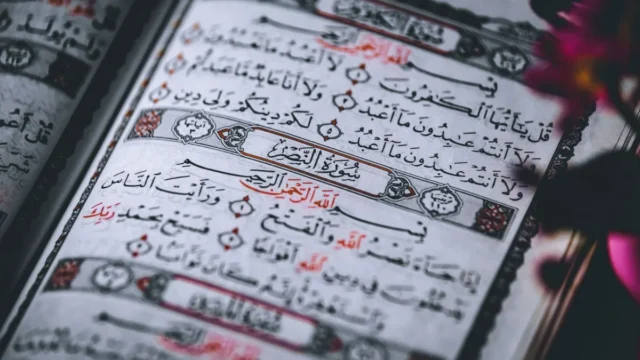
- Use a colour-coded Mushaf. Many Tajweed Mushafs mark qalqalah letters in a particular colour, which helps you spot them while reading.
For parents, a short daily slot after school or before bed works well. Our guide to helping children build a Quran learning routine has more ideas.
Where qalqalah fits in your learning
Qalqalah only makes sense once you can read Arabic letters with their vowels and sukoon. If you or your child are still learning to join letters, start with the Noorani Qaida course, which introduces sukoon and the basic sounds step by step. Learners who already read fluently can work on qalqalah, the rules of noon sakinah and tanween and the other rules in our Quran with Tajweed course, where the teacher listens as you recite and corrects each mistake as it happens.
Online lessons in the US and UK
Lessons are live and one-to-one, so you choose the time. In the US, many families book after school or early evening in their own time zone, whether that is Eastern, Central, Mountain or Pacific. In the UK, after-school slots and weekend mornings are popular, and lesson times move with the clocks between GMT and BST. If you are in America, our tips on preparing for Quran lessons in US time zones may help you plan.
Frequently asked questions
What are the 5 qalqalah letters?
The qalqalah letters are ق (qaf), ط (ta), ب (ba), ج (jeem) and د (dal). They are often remembered with the phrase قُطْبُ جَدٍّ (qutbu jad).
When do you apply qalqalah?
Apply qalqalah when one of the five letters has a sukoon, either written in the word or created by stopping at the end of a word. There is no qalqalah when the letter has a fatha, kasra or damma.
What is the difference between qalqalah sughra and kubra?
Qalqalah sughra is the lighter bounce in the middle of a word or when reading on. Qalqalah kubra is the stronger bounce when you stop on a qalqalah letter, usually at the end of a verse.
Is ت (ta) a qalqalah letter?
No. Only the heavy ط has qalqalah. The light ت is pronounced with a breathy release and should not be bounced.
Can a child learn qalqalah?
Yes. Children usually pick it up quickly by copying a teacher, especially once they can read letters with sukoon. Short surahs like Al-Ikhlas and Al-Falaq are good places to start.
Practise qalqalah with a teacher
Reading about qalqalah is a good start, but it becomes natural when someone listens and corrects you. Book a free evaluation lesson and a teacher will check your reading, explain where you are, and suggest the right course, or message us on WhatsApp with any questions. If you already know which course you want, you can also enrol directly.
Ready to recite with confidence? One-to-one online lessons for children and adults, at times that suit families in the US and the UK.
Written by the Home Quran Tutors team. This article is general guidance for learners and parents; for religious rulings, please ask your teacher or a qualified scholar you trust.